
MARINO PH
Your Maritime Digital Hub

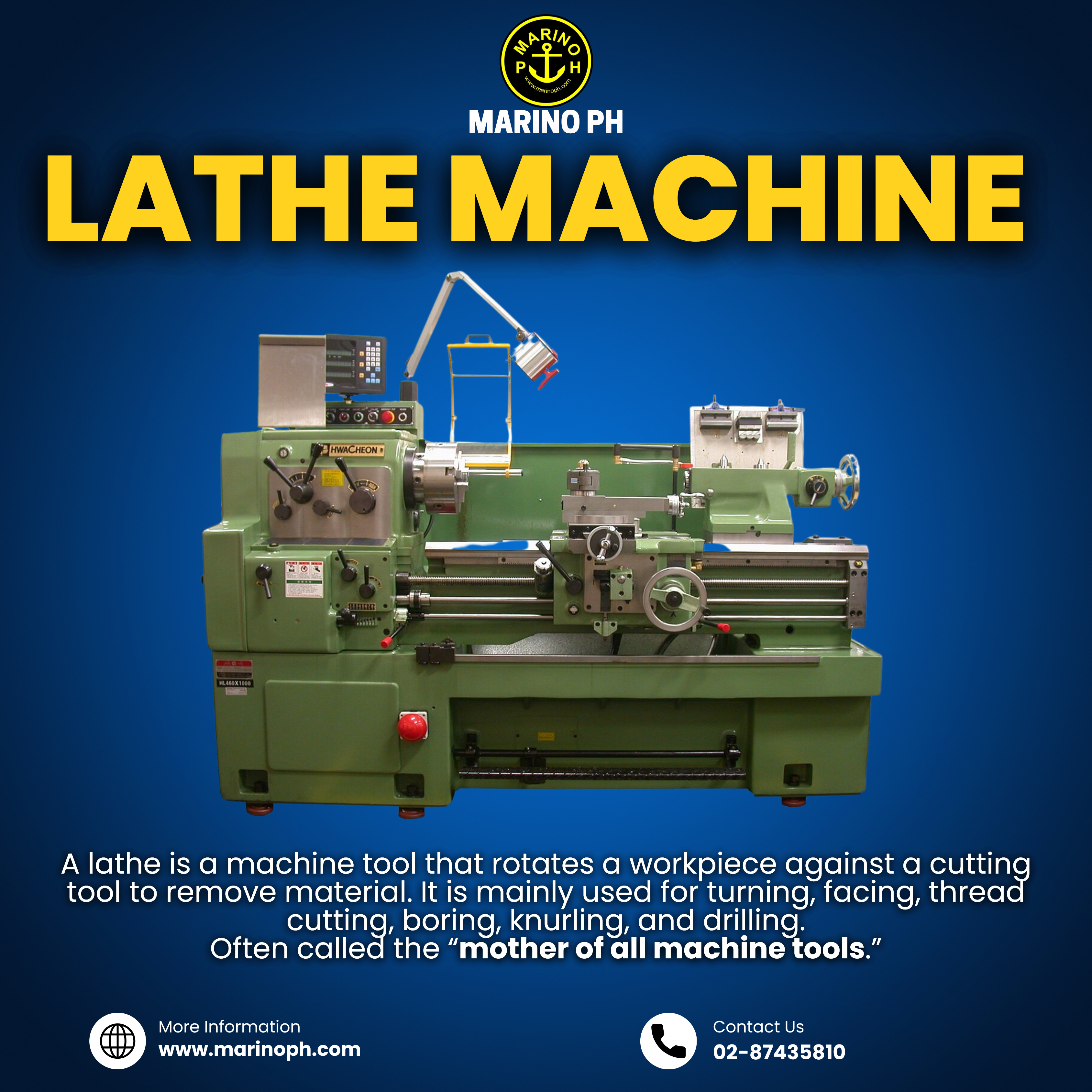
LATHE MACHINE; THE MOTHER OF ALL MACHINES
A lathe machine is a powerful tool in both industrial and maritime workshops. By rotating a workpiece against a cutting tool, it enables precise shaping, drilling, and finishing of materials. This makes it vital for manufacturing components such as shafts, propeller parts, and other cylindrical items that require high accuracy.
How a Lathe Machine Works
At its core, a lathe machine consists of a headstock, tailstock, bed, and carriage. The headstock houses the spindle and speed controls, delivering rotational motion to the workpiece. The tailstock provides support and can hold auxiliary tools like drills or reamers. The bed acts as a rigid base, ensuring that all other components remain aligned. Mounted on the bed, the carriage including the saddle, cross-slide, and tool post movably carries the cutting tool, while the lead screw and feed rod drive the tool’s motion for threading and feeding.
Operations You Can Do on a Lathe
Lathes are extremely versatile. Here are some of the most common operations:
Turning: Reducing the diameter of a workpiece to form cylinders or tapered shapes.
Facing: Creating flat surfaces on the ends of the piece.
Parting: Cutting off a portion of the workpiece.
Boring: Enlarging existing holes or providing a precise internal diameter.
Thread Cutting: Cutting internal or external screw threads.
Knurling: Forming patterned grips on handles or tool surfaces.
Drilling: Using a drill held in the tailstock to bore holes with high accuracy.

ADVERTISMENT
Applications in Marine and Industrial Fields
Lathe machines have vast applications. In the maritime industry, they are used to fabricate or repair shafts, couplings, propeller hubs, and marine components that must endure high stress, lathes produce critical machine parts, precision components, and prototypes. Their flexibility also makes them a staple in toolrooms and maintenance workshops.
Why Lathe Machines Matter
The lathe machine remains a cornerstone of manufacturing and maintenance operations. Its ability to produce precise, symmetrical parts quickly and efficiently gives it lasting value. Whether you're training new machinists, maintaining marine equipment, or producing precision tooling, the lathe’s adaptability and performance make it an essential asset for any workshop.
