MARINO PH
Your Maritime Digital Hub

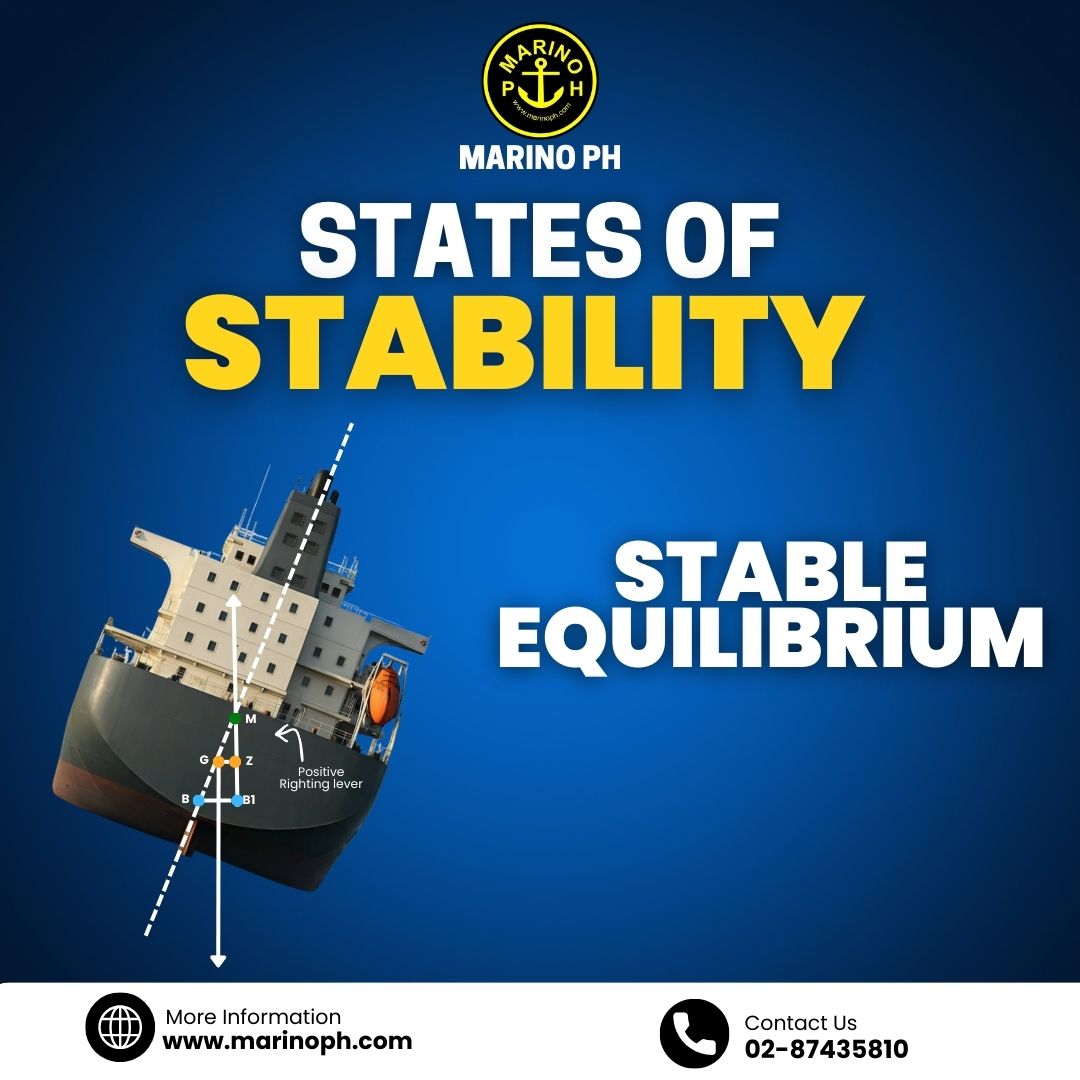
The state of stability of a cargo ship describes how the vessel behaves when it is inclined by an external force such as waves, wind, cargo shift, or turning. It is governed by the relationship between the ship’s center of gravity (G) and metacenter (M). There are three fundamental states of stability: stable, neutral, and unstable.
⸻
1. Stable Equilibrium (Stable Stability)
A cargo ship is in stable equilibrium when, after being inclined by an external force, it naturally returns to its original upright position once the force is removed.
This condition occurs when the metacenter (M) is above the center of gravity (G), giving the ship a positive metacentric height (GM). When the vessel heels, a righting moment is created that pushes the ship back upright.
In practice, a stably loaded cargo ship feels firm, resists rolling, and recovers quickly from small angles of heel. This is the desired and safest condition for all cargo vessels.

2. Neutral Equilibrium (Neutral Stability)
A cargo ship is in neutral equilibrium when, after being inclined, it remains at the new angle without either returning upright or capsizing further.
This happens when the metacenter (M) coincides exactly with the center of gravity (G), resulting in a zero GM. In this state, there is no righting moment and no overturning moment.
Although the ship does not immediately capsize, neutral stability is unsafe in real sea conditions, as any small disturbance, cargo shift, or change in loading can easily push the vessel into an unstable condition.

3. Unstable Equilibrium (Unstable Stability)
A cargo ship is in unstable equilibrium when, after being inclined, it continues to heel further instead of returning upright.
This occurs when the center of gravity (G) is above the metacenter (M), producing a negative GM. In this case, an overturning moment is generated, increasing the angle of heel and potentially leading to capsizing.
Unstable stability is extremely dangerous and commonly associated with high cargo stowage, liquefaction of bulk cargoes, free surface effect, or improper loading.

ADVERTISEMENT
