
MARINO PH
Your Maritime Digital Hub

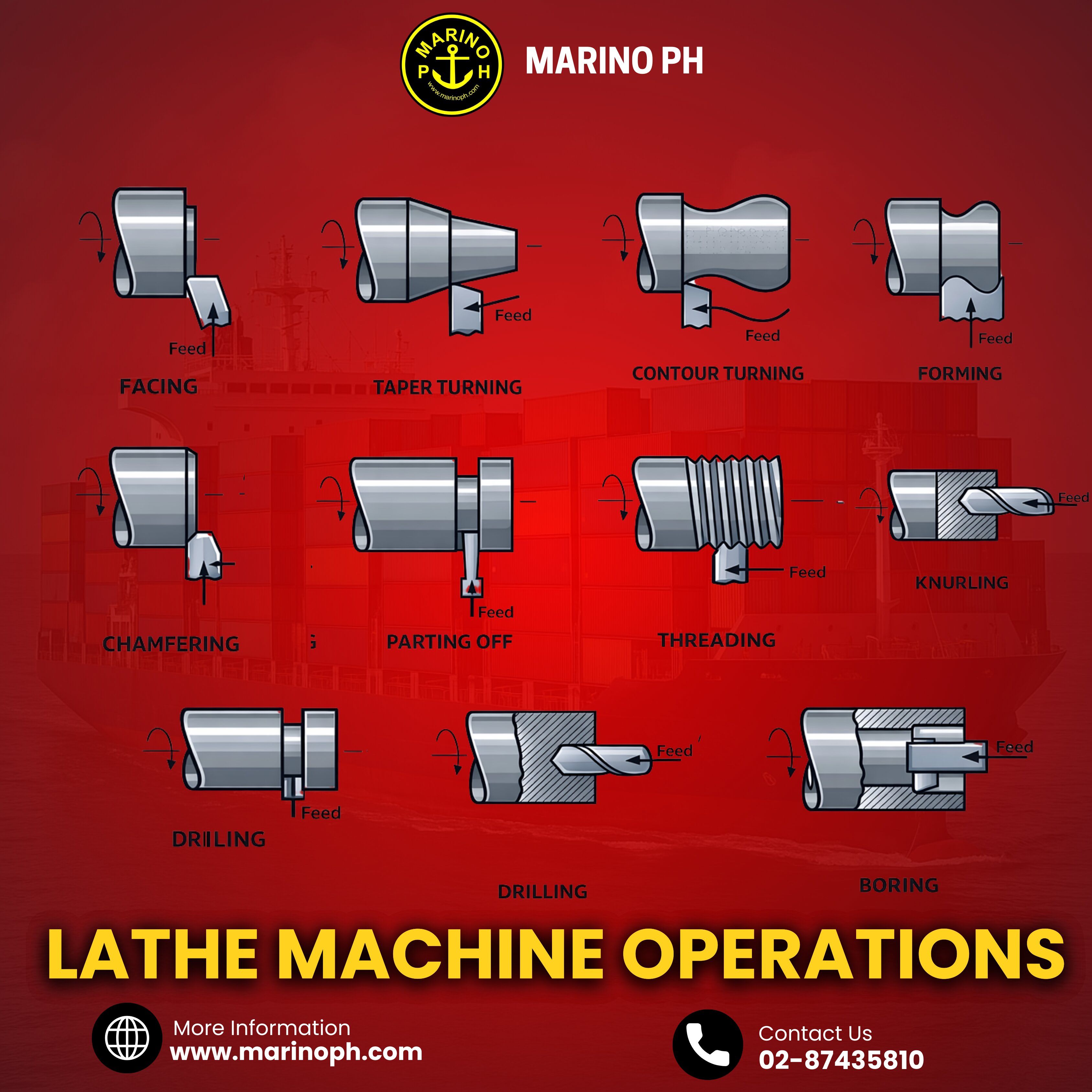
Lathe Machine Operations
Lathe machines are fundamental tools in machining and marine engineering, designed to shape metal components with precision and consistency. By rotating the workpiece against a stationary cutting tool, a lathe enables the production of cylindrical, conical, and threaded parts commonly used in ship machinery, propulsion systems, and industrial equipment.
Common Lathe Operations
Facing
Facing is used to produce a flat, smooth surface at the end of a workpiece. This operation ensures accurate length and proper seating of components.
Taper Turning
Taper turning creates a gradual reduction or increase in diameter along the length of a component. This is essential for shafts, couplings, and alignment-critical parts.
Contour Turning
Contour turning allows complex and curved profiles to be machined, often required for custom marine parts and specialized fittings.

ADVERTISMENT
Forming
Forming uses a shaped cutting tool to produce specific profiles in a single pass, improving efficiency for repetitive manufacturing tasks.
Chamfering
Chamfering removes sharp edges and creates beveled corners, enhancing safety, assembly ease, and component durability.
Parting Off
Parting off separates finished components from the raw material, ensuring clean cuts and precise dimensions.
Threading
Threading produces internal or external threads required for bolts, nuts, and pipe connections used extensively in marine systems.
Knurling
Knurling creates textured surfaces to improve grip, commonly applied to handles, knobs, and adjustment components.
Drilling and Boring
Drilling produces initial holes, while boring enlarges and refines them to achieve precise internal diameters and alignment.
